


We welcome you to become a paid subscriber for access to the internal notes behind The Long Way Home: Lesath, Montana.
Internal Notes Behind “Urban Futurism” Vignette
by Charles Rosenbauer
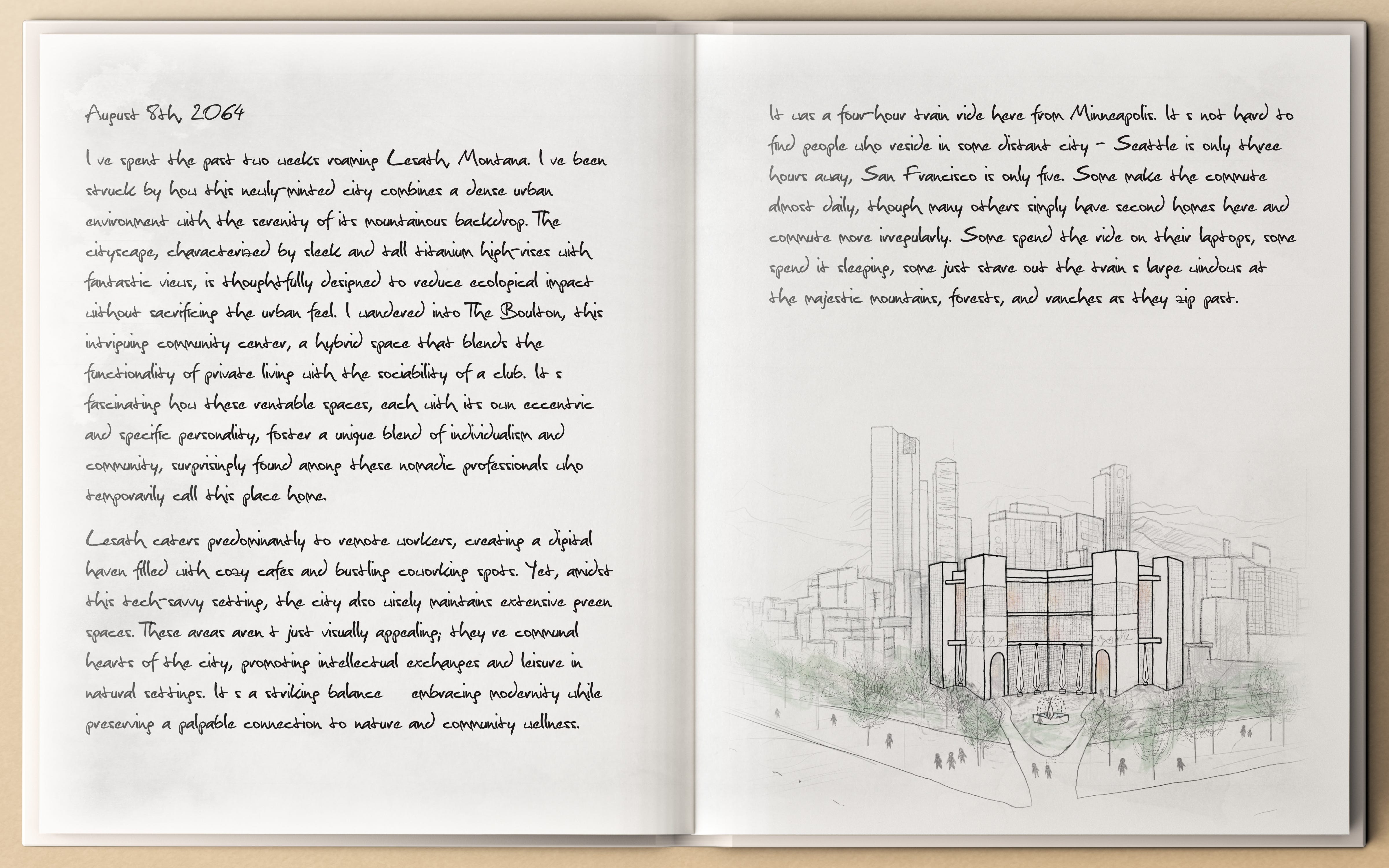
The vignette takes place in a newly constructed city in Montana. It is built to be somewhat dense to minimize environmental impact and is otherwise in a very rural, mountainous, and overall beautiful area. While there is somewhat of a local geothermal energy industry, and there are some nearby areas with mining, the majority of the population consists of remote workers who spend time in the city for its natural beauty. There are perhaps 100,000 or so people in the city, though the density makes it feel somewhat more populous. The taller buildings that enable this population density are partially a product of improvements in construction (including much cheaper titanium alloys) and the higher average wealth of these remote workers.
There is a third-space-community-center type building, kind of social club equivalent of an industrial garden. There are rentable spaces for offices and clubs. There are also rentable rooms and storage spaces. People can store personal items while out of the city, and can bring them to a rented room while they are in town.
Being mostly for remote workers, the city is optimized around knowledge work and other things that require little physical capital. There is a lot of local infrastructure and many local businesses built around laptops, smartphones, and perhaps some more novel digital devices, but few warehouses and places for heavy industry. There are some to maintain grocery stores, Amazon fulfillment centers (or whatever replaces Amazon), and whatever is needed by the local geothermal industry, but by-and-large there are far more cafes and coworking spaces than there are factories and labs.
Not everyone in the city is a remote worker of course. Some people run local businesses that will have a reason to stay no matter who moves in or out; cafes, restaurants, gyms, hospitals, and other recreation and basic services. Other people may run office-based businesses with a somewhat permanent local workforce that take advantage of the flow of talent through the area.
Cities should have big, well-maintained green spaces. There is a park in this city with many large, public spaces. There are trees, grass, and ponds, but there are also water fountains, stone paths, outdoor theaters, outdoor religious spaces, and more.
There are cafes that sponsor local or visiting intellectuals to spend time in the cafes to talk to people, and occasionally give presentations. Presentations also occasionally happen at the outdoor theaters in the parks.
The city gets cold in the winter, and some thought is put into how to keep the city beautiful both when it is green and warm and when it is white and cold.
Being built from scratch and relatively new, there was almost no pre-existing infrastructure to constrain city layout and transportation. There are roads for cars - something must solve the last-mile transportation problem after all - but much of the city is designed around walkable areas, and many common paths are handled by underground rail. Rather than dig tunnels underneath the city, rail was built at the surface and the city was built, elevated, on top, comparable though not exactly the same as was done in Chicago.
There is a high speed rail connection linking to other parts of the country. There is not an airport in the city, but those determined to fly can take a train to “nearby” cities that do have airports. This part of the country is still relatively sparsely populated however.
Thank you for supporting Possibilia Magazine. If you know someone who might enjoy The Long Way Home: Lesath, Montana, please share!